Currency Exchange API vs Web Scraping: Why APIs Win

I’m an SEO specialist with a passion for helping businesses grow their online presence through smart, data-driven strategies. I focus on optimising websites to improve search rankings, drive organic traffic, and increase conversions. With experience in keyword research, on-page and technical SEO, and content optimisation, I ensure that websites are not just search engine-friendly but also user-friendly. I stay updated with algorithm changes and industry trends to implement effective SEO tactics that deliver long-term results. Whether it's improving site structure, fixing technical issues, or crafting SEO-friendly content, I believe in transparency and delivering real value.
When an application needs current exchange rates, developers usually have two options: connect to a currency exchange api or collect information from financial websites through web scraping. Both approaches can retrieve currency data, but they work in very different ways. Scraping depends on the structure and availability of a website, while an API provides data through a defined interface built for software applications. For businesses that need dependable exchange rate information, understanding this difference can help determine which approach fits their technical and operational requirements.
What Is Web Scraping for Currency Data?
Web scraping involves using a program to visit a website, locate specific information within its HTML or page structure, extract the required values, and then process those values for an application.
For example, a developer might create a script that visits a currency information page, searches for USD, EUR, GBP, or other currency values, and stores the results in a database.
The process may appear straightforward, especially when the required information is publicly visible. However, websites are primarily designed for people to browse rather than for applications to consume structured financial data.
A scraper therefore has to understand the page layout. If the website changes its HTML structure, moves an element, introduces dynamic content, or modifies how rates are displayed, the scraper may stop returning the expected information.
This creates an ongoing maintenance requirement for development teams.
How Does a Currency Exchange API Work?
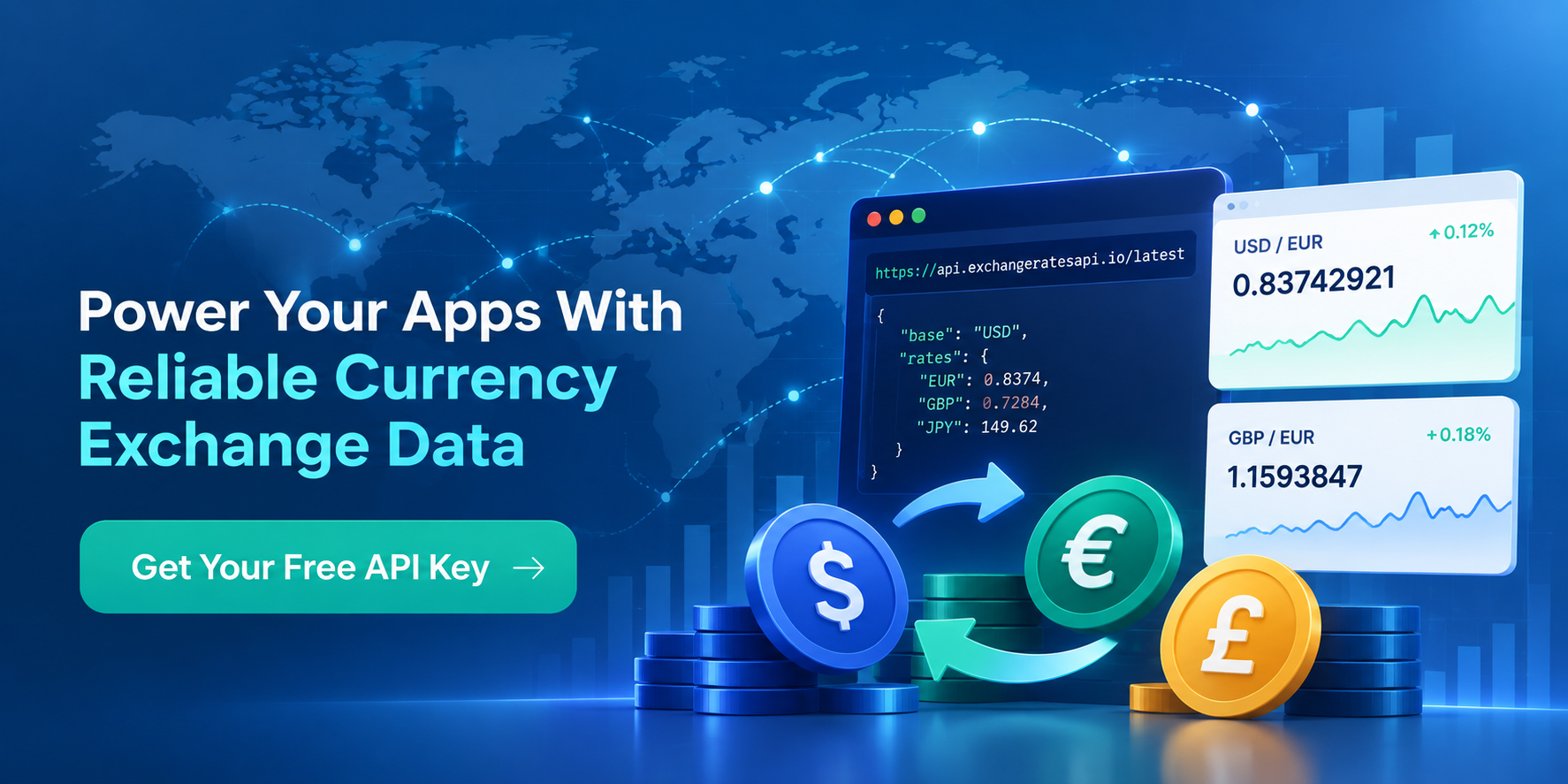
An API provides a structured communication layer between an application and a data service. Instead of interpreting a webpage, the application sends a request to a specific endpoint and receives data in a machine-readable format.
Currency APIs commonly return JSON responses containing information such as:
Base currency
Target currency
Exchange rate
Date
Timestamp
Historical rate information
Conversion results
For example, an application can request the latest rates for selected currencies and process the returned JSON directly. This approach eliminates the need to identify HTML elements or extract values from a visual webpage.
Exchange Rates API documentation describes endpoints for latest rates, currency conversion, historical rates, time-series information, and fluctuation data. Its responses use structured JSON, making the returned information easier for software to parse and integrate.
Why APIs Are More Reliable for Applications
Reliability is one of the biggest differences between the two approaches.
A scraper depends on another website's presentation layer. If a website changes its page structure, the extraction logic may need to be rewritten. A small frontend modification can potentially affect the data collection process.
An API, on the other hand, is designed around defined endpoints and parameters. Developers know what request to make and what type of response to expect.
This makes APIs more suitable for applications where currency information is part of an ongoing workflow.
For example, an ecommerce platform may need exchange rates whenever customers view prices in different currencies. An accounting application may need currency information for financial calculations. A travel application may use exchange rates to display estimated costs for international destinations.
In each case, predictable data access is more useful than repeatedly interpreting webpage content.
Structured Data Reduces Development Work
One of the less obvious advantages of an API is the amount of processing it can save.
With scraping, developers often need to:
Request a webpage.
Load or parse its HTML.
Identify the relevant section.
Extract the rate.
Clean the extracted value.
Handle formatting differences.
Validate the result.
Store or process the information.
An API can reduce much of this work because the provider delivers data in a format intended for software consumption.
Structured responses can also make it easier to map currency values to application fields. Instead of extracting text from a page, developers can work with predictable objects such as a base currency, date, timestamp, and rates.
That difference becomes increasingly important as an application grows.
APIs Offer Better Access to Historical Data
Current exchange rates are only one requirement for many applications. Businesses may also need historical information to analyze trends, calculate previous transactions, prepare reports, or compare currency movements over a specific period.
Building a reliable historical database through scraping can be complicated. A developer must identify suitable pages, determine whether historical information is consistently available, and create a process for collecting and organizing the data.
A dedicated API can provide historical endpoints specifically designed for this purpose.
Exchange Rates API documentation states that historical rates can be requested for specific dates, while its time-series functionality can return daily rates across a selected period.
This gives developers a more direct way to integrate historical exchange rate information into applications without building a separate scraping system.
Data Freshness Matters
Currency values change over time, so the age of a rate matters.
A webpage may show updated information, but a scraper has no inherent guarantee that the information will be available in the exact format or at the frequency an application requires. Developers also need to decide how often their scraper should run.
An API can make update schedules easier to understand and manage.
Exchange Rates API states that its exchange rate data can be refreshed according to the subscription plan, with some plans supporting updates as frequently as every 60 seconds.
This can be useful for applications where the difference between an older rate and a recently updated rate affects calculations or displayed information.
Scalability Is Another Important Difference
A small script that scrapes a website occasionally may work for a personal project. The situation changes when thousands of users depend on the same data.
High-volume scraping can create additional challenges around request frequency, website restrictions, HTML processing, proxy infrastructure, error handling, and data storage.
APIs are generally designed to handle programmatic requests according to defined usage limits and subscription plans.
For example, an application can request only the currencies it needs rather than processing an entire webpage. Exchange Rates API supports selecting specific output currencies through request parameters, which can help reduce unnecessary data transfer.
This type of control becomes useful when applications make frequent requests.
Maintenance Costs Can Favor APIs
The initial development effort is not the only cost to consider.
A scraping system may require continuous maintenance because the target website can change independently of your development team. A redesigned page, renamed CSS class, changed JavaScript behavior, or modified content structure can break an extraction workflow.
An API reduces this dependency because the application communicates with a documented interface rather than the visual structure of a webpage.
That does not mean APIs require no maintenance. Developers still need to manage authentication, request limits, errors, version changes, and application security. However, the integration is generally based on a defined technical contract rather than assumptions about how a webpage is constructed.
Security and Data Handling
Financial applications should also consider how data enters their systems.
Scraping may involve accessing websites repeatedly and processing larger amounts of page content than the application actually needs. APIs allow developers to request specific datasets and integrate them into their existing security and data-handling processes.
Authentication is another important consideration. Exchange Rates API uses API access keys to authenticate requests, and its documentation provides guidance for integrating those keys with API calls.
Developers should still protect credentials properly by avoiding hardcoded keys in publicly accessible frontend code or repositories.
When Could Web Scraping Still Make Sense?
Web scraping is not inherently useless. There are situations where it can be appropriate.
For example, scraping may be considered when information is available only on a particular website and no suitable API exists. It can also be useful for research, monitoring publicly available pages, or collecting information from sources that explicitly permit automated access.
However, developers should review the website's terms, robots directives, access policies, copyright considerations, and applicable laws before building a scraper.
For a production application that requires recurring exchange rate data, the availability of a dedicated API usually changes the technical calculation. Instead of building infrastructure around webpage extraction, developers can integrate a service intended to deliver structured data.
Currency Exchange API vs Web Scraping: Key Differences
The choice becomes clearer when the two approaches are considered from an application-development perspective.
A scraper works with webpages, so it is closely tied to presentation and page structure. An API works with endpoints, parameters, and structured responses.
Scraping can require more effort for data cleaning and validation. APIs generally provide information in a format that can be processed directly.
Scrapers may need frequent adjustments when websites change. APIs provide documented integration points, although developers still need to monitor API updates and usage limits.
For historical data, APIs can also provide dedicated endpoints instead of requiring developers to locate and reconstruct information from multiple webpages.
For these reasons, an API is often a more practical foundation when currency data is an ongoing part of an application rather than a one-time research requirement.
How to Choose the Right Currency Data Solution
Before selecting a provider, developers should look beyond the advertised number of currencies.
Consider how frequently rates are updated, which currencies are available, whether historical data is supported, how many requests the application requires, and what response format is provided.
It is also worth checking whether the service supports currency conversion, time-series data, fluctuation information, HTTPS, authentication, and appropriate usage limits.
Exchange Rates API provides endpoints covering current rates, historical data, conversions, time-series queries, and currency fluctuation information.
The right choice ultimately depends on the application's requirements, expected traffic, data freshness needs, and budget.
A Practical Option for Developers
For teams that want to avoid building and maintaining a scraping workflow, Exchangeratesapi provides a dedicated exchange rate API for retrieving currency information in a structured format.
The service supports more than 200 currencies according to its product page, while its documentation describes access to current, historical, conversion, time-series, and fluctuation data.
Its plans are structured around different request volumes and update frequencies, allowing developers to select an option based on application requirements.
Simplify Currency Data Integration With Exchangeratesapi
If your application needs reliable exchange rate data without maintaining HTML parsers or monitoring changing webpage layouts, Exchangeratesapi offers a straightforward API-based approach. Developers can work with structured currency data, request specific currencies, access historical information, and use dedicated conversion functionality according to their plan. It can be a practical option for ecommerce platforms, financial applications, accounting tools, dashboards, and other software that needs programmatic currency data.
Frequently Asked Questions
1. Is a currency API better than web scraping for exchange rates?
For applications that regularly require exchange rate information, an API generally provides a more structured integration approach. It avoids depending on webpage layouts and can provide endpoints designed specifically for current rates, conversions, and historical information.
2. Why can currency scraping break unexpectedly?
A scraper depends on the structure of the webpage it reads. If the website changes its HTML, CSS selectors, JavaScript behavior, or content layout, the extraction logic may stop working correctly. This means developers may need to update the scraper whenever significant structural changes occur.
3. Can an API provide historical currency exchange rates?
Yes. Many dedicated currency APIs provide historical endpoints. Exchange Rates API, for example, documents historical rate queries as well as time-series functionality for retrieving rates over selected periods.
4. What should developers check before choosing a currency API?
Developers should examine supported currencies, update frequency, request limits, historical coverage, conversion features, response formats, authentication, security options, pricing, and documentation. It is also useful to confirm that the provider can handle the expected request volume.
5. Is web scraping suitable for a financial application?
It can be technically possible, but it introduces additional considerations around website structure, reliability, access policies, maintenance, and data validation. When a suitable dedicated API is available, developers can evaluate whether its structured interface better fits the application's requirements.
Conclusion
Choosing between scraping and an API depends on what the application needs to accomplish. Scraping can retrieve information from webpages, but it places responsibility on developers to interpret page structures, maintain extraction rules, validate results, and respond to website changes. A dedicated API provides a purpose-built interface that can make recurring data integration more predictable. For applications that depend on current or historical currency information, structured access can simplify development and ongoing maintenance. When evaluating an api currency exchange solution, developers should consider data freshness, supported currencies, historical coverage, request volume, security, documentation, and the features required by their specific application.